Angkor Wat (/ˌæŋkɔːr ˈwɒt/; Khmer: អង្គរវត្ត, “City/Capital of Sanctuaries”) is a sanctuary complex in Cambodia and one of the biggest religious landmarks
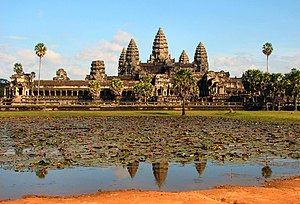
on the planet, on a site estimating 162.6 hectares (1,626,000 m2; 402 acres).[1] Initially developed as a Hindu sanctuary devoted to the god Vishnu for the Khmer Realm, it was progressively changed into a Buddhist sanctuary towards the finish of the twelfth century.[2] It was worked by the Khmer Lord Suryavarman II[3] in the mid twelfth century in Yaśodharapura (Khmer: យសោធរបុរៈ, present-day Angkor), the capital of the Khmer Domain, as his state sanctuary and inevitable sepulcher. Parting from the Shaiva convention of past rulers, Angkor Wat was rather committed to Vishnu. As the best-safeguarded sanctuary at the site, it is the just one to have remained a noteworthy religious focus since its establishment. The sanctuary is at the highest point of the high traditional style of Khmer design. It has turned into an image of Cambodia,[4] showing up on its national banner, and it is the nation’s prime fascination for visitors.[5]
Etymology
Angkor Wat joins two fundamental plans of Khmer sanctuary engineering: the sanctuary mountain and the later galleried sanctuary. It is intended to speak to Mount Meru, home of the devas in Hindu folklore: inside a channel in excess of 5 kilometers (3 mi) long[6] and an external divider 3.6 kilometers (2.2 mi) long are three rectangular exhibitions, each raised over the following. At the focal point of the sanctuary stands a quincunx of towers. Not at all like most Angkorian sanctuaries, Angkor Wat is arranged toward the west; researchers are partitioned with regards to the essentialness of this. The sanctuary is respected for the loftiness and agreement of the engineering, its broad bas-reliefs, and for the various devatas decorating its dividers.
Historical underpinnings
The cutting edge name, Angkor Wat (Khmer: អង្គរវត្ត) (substitute name: Nokor Wat, Khmer: នគរវត្ត),[7] signifies “Sanctuary City” or “City of Sanctuaries” in Khmer; Angkor (Khmer: អង្គរ) signifying “city” or “capital city”, is a vernacular type of the word nokor (Khmer: នគរ), which originates from the Sanskrit word nagara (Devanāgarī: नगर).[8] Wat (Khmer: វត្ត) is the Khmer word for “sanctuary grounds”, likewise got from Sanskrit vāṭa (Devanāgarī: वाट), signifying “enclosure”.[9]
According to the fantasy of AngorWat being the Female Awesome Standard, and the Hindu Yoni (Belly) Engineering of the Sanctuary Complex affirms it, “angor” is Sanskrit “aɲkur” (ɲ is a palatal nasal) which means the “germination” or “birthing” rule. Sanskit “Tank” or “vaat” signifies vitality or Sanskrit praNa. So AngorWat is ‘aɲkur Tank’.
The first name of the sanctuary was Vrah Viṣṇuloka or Parama Viṣṇuloka (Sanskrit), (Khmer: បរមវិស្ណុលោក – Barom Visnulōk) which means the consecrated dwelling of Vishnu.
History
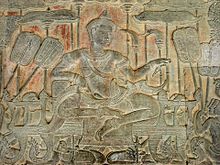
Ruler Suryavarman II, the manufacturer of Angkor Wat
Angkor Wat lies 5.5 kilometers (3.4 mi) north of the cutting edge town of Siem Harvest, and a short separation south and somewhat east of the past capital, which was focused at Baphuon. In a zone of Cambodia where there is a significant gathering of antiquated structures, it is the southernmost of Angkor’s principle destinations.
As indicated by legend, the development of Angkor Wat was requested by Indra to fill in as a royal residence for his child Precha Ket Mealea.[10] As per the thirteenth century Chinese voyager Zhou Daguan, some accepted that the sanctuary was built in a solitary night by a perfect architect.[11]
The underlying structure and development of the sanctuary occurred in the principal half of the twelfth century, during the rule of Suryavarman II (ruled 1113 – c. 1150). Committed to Vishnu, it was worked as the lord’s state sanctuary and capital city. As neither the establishment stela nor any contemporary engravings alluding to the sanctuary have been discovered, its unique name is obscure, however it might have been known as “Varah Vishnu-lok” after the managing divinity. Work appears to have finished soon after the ruler’s demise, leaving a portion of the bas-help improvement unfinished.[12] In 1177, roughly 27 years after the passing of Suryavarman II, Angkor was sacked by the Chams, the customary foes of the Khmer.[13] From that point the realm was reestablished by another lord, Jayavarman VII, who set up another capital and state sanctuary (Angkor Thom and the Bayon separately) a couple of kilometers toward the north.
Towards the finish of the twelfth century, Angkor Wat step by step changed from a Hindu focal point of love to Buddhism, which proceeds to the present day.[2] Angkor Wat is uncommon among the Angkor sanctuaries in that in spite of the fact that it was to a great extent ignored after the sixteenth century it was never totally abandoned.[14] Fourteen engravings dated from the seventeenth century found in Angkor region vouch for Japanese Buddhist travelers that had set up little settlements close by Khmer locals.[15] around then, the sanctuary was thought by the Japanese guests as the popular Jetavana greenhouse of the Buddha, which initially situated in the kingdom of Magadha, India.[16] The best-realized engraving recounts Ukondafu Kazufusa, who praised the Khmer New Year at Angkor Wat in 1632.[17]
Veneer of Angkor Wat, an illustration by Henri Mouhot, c. 1860
Sketch of Angkor Wat, an illustration by Louis Delaporte, c. 1880
One of the principal Western guests to the sanctuary was António da Madalena, a Portuguese minister who visited in 1586 and said that it “is of such uncommon development that it is beyond the realm of imagination to expect to portray it with a pen, especially since it resembles no other structure on the planet. It has towers and adornment and every one of the refinements which the human virtuoso can consider of.”[18]
In the mid-nineteenth century, the sanctuary was viably rediscovered by the French naturalist and pioneer Henri Mouhot, who promoted the site in the West through the production of movement notes, in which he composed:
” One of these sanctuaries, an adversary to that of Solomon, and raised by some antiquated Michelangelo, may assume a decent position alongside our most delightful structures. It is more terrific than anything left to us by Greece or Rome, and presents a miserable differentiation to the condition of savageness in which the country is currently plunged.[19] “
Angkor Wat may identify with the engineering of the Greek and Roman record investigated as far as the west as opposed to east direction of the sanctuary. A few designers have composed that it is ‘right’ for the development to confront the west. In sanctuary directions for the Greek and Etruscan setting, west is related with “right” and the “black market” to recommend a religious association of the building.[20]
Mouhot, as other early Western guests, thought that it was hard to accept that the Khmers could have fabricated the sanctuary and erroneously dated it to around a similar time as Rome. His reports motivated the French government, as of now a built up nearness in Indochina, to start an efficient investigation of the remains. The genuine history of Angkor Wat was sorted out from expressive and epigraphic proof collected during ensuing clearing and reclamation work. There were no normal homes or houses or different indications of settlement, including cooking utensils, weapons, or things of dress generally found at antiquated destinations. Rather there is just the proof of the landmarks themselves.[21] An investigation commission started drawing up a rundown of head landmarks. Consequent missions replicated engravings composed on Angkor structures so researchers may decipher them and get the hang of something of Angkor’s history. By 1885 they had stirred up a sequence of the rulers and built up the blueprints of a portrayal of the progress that had created the sanctuary complex. In 1898 the French chose to submit considerable assets to Angkor’s conservation. Hundreds of years of disregard had allowed the wilderness to recover a significant number of the more huge structures, and except if endeavors were made to liberate the structures from the grasp of colossal banyan and silk-cotton trees, they may before long be squashed to obliteration.
The twentieth century saw impressive rebuilding of Angkor Wat.[22] Bit by bit groups of workers and archeologists pushed back the wilderness and uncovered the regions of stone, allowing the sun by and by to enlighten the dim corners of the sanctuary. Work was hindered by the Cambodian Common War and Khmer Rouge control of the nation during the 1980s, yet moderately little harm was finished during this period. Outdoors Khmer Rouge powers utilized whatever wood stayed in the structure structures for kindling, and a shoot-out between Khmer Rouge and Vietnamese powers put a couple of shot openings in a bas alleviation. Unquestionably more harm was done after the wars, by workmanship cheats working out of Thailand, which, in the late 1980s and mid 1990s, guaranteed pretty much every head that could be trimmed off the structures, including reconstructions.[23]
The sanctuary is an amazing image of Cambodia, and is a wellspring of incredible national pride that has figured into Cambodia’s discretionary relations with France, the US and its neighbor Thailand. A portrayal of Angkor Wat has been a piece of Cambodian national banners since the presentation of the primary adaptation around 1863.[24] From a bigger chronicled and even transcultural point of view, be that as it may, the sanctuary of Angkor Wat did not turn into an image of national pride sui generis however had been engraved into a bigger politico-social procedure of French-pioneer legacy creation in which the first sanctuary site was introduced in French pilgrim and widespread shows in Paris and Marseille somewhere in the range of 1889 and 1937.[25] Angkor Wat’s style were likewise in plain view in the mortar cast historical center of Louis Delaporte called musée Indo-chinois which existed in the Parisian Trocadero Royal residence from c.1880 to the mid-1920s.[26]
The wonderful creative heritage of Angkor Wat and other Khmer landmarks in the Angkor district drove straightforwardly to France receiving Cambodia as a protectorate on 11 August 1863 and attacking Siam to assume responsibility for the remnants. This immediately prompted Cambodia recovering grounds in the northwestern corner of the nation that had been under Siamese (Thai) control since Promotion 1351 (Manich Jumsai 2001), or by certain records, Advertisement 1431.[27] Cambodia picked up freedom from France on 9 November 1953 and has controlled Angkor Wat since that time. It is sheltered to state that from the provincial time frame onwards until the site’s assignment as UNESCO World Legacy in 1992, this particular sanctuary of Angkor Wat was instrumental in the development of the cutting edge and step by step globalized idea of assembled social heritage.[28]
In December 2015, it was reported that an exploration group from College of Sydney had discovered a formerly concealed gathering of covered towers manufactured and destroyed during the development of Angkor Wat, just as gigantic structure of obscure reason on its south side and wooden strongholds. The discoveries likewise incorporate proof of low-thickness private occupation in the district, with a street matrix, lakes and hills. These show that the sanctuary area, limited by channel and divider, might not have been utilized solely by the holy first class, as was recently thought. The group utilized LiDAR, ground-entering radar and focused on uncovering to outline Wat.[29]
Engineering
Plan of Angkor Wat
General arrangement of Angkor Wat with focal structure in the center
Point by point plan of the focal structure
Site and plan
Ethereal perspective on Angkor Wat
Angkor Wat, situated at 13°24′45″N 103°52′0″E, is a special blend of the sanctuary mountain (the standard structure for the domain’s state sanctuaries) and the later arrangement of concentric displays. The development of Angkor Wat additionally proposes that there was a heavenly criticalness with specific highlights of the sanctuary. This is seen in
 Khmer Traditional